If someone texts you “D-Day is coming,” you might wonder if they are talking about history, a big deadline, or something else entirely.
The good news is that the meaning is usually easy to understand once you know the context.
In everyday texting, social media, gaming, work chats, and online conversations, D-Day often refers to an important day when something is scheduled to happen.
It can be the day of an exam, a wedding, a product launch, a deadline, a major event, or any moment someone has been waiting for.
However, D-Day has more than one meaning.
It also has a famous historical meaning connected to June 6, 1944, when Allied forces landed in Normandy during World War II.
So, what does D-Day mean in text? How do you use it naturally? And why do people still say it today?
Let’s break it down in simple terms.
Updated for 2026, this guide explains the D-Day meaning, its historical origin, modern texting use, examples, common misunderstandings, and related abbreviations.
What Does D-Day Mean in Texting?
In texting and casual conversation, D-Day usually means the important day when something is supposed to happen.
The “D” can be understood as referring to the day of an event or operation. In modern everyday language, people often use D-Day to describe a date that feels especially important, serious, or exciting.
For example:
“My final exam is D-Day for me.”
This means the final exam is a very important day for the person.
Another example:
“D-Day is finally here! We’re moving into our new house.”
Here, D-Day means the big day when the move is happening.
In simple words:
D-Day = The big or important day when something happens.
Depending on the conversation, it can refer to:
- A deadline
- An exam
- A wedding
- A job interview
- A sports event
- A product launch
- A vacation
- A military operation
- A major personal event
The exact meaning depends on the context.
What Is the Historical Meaning of D-Day?
The term D-Day has a very important historical meaning.
In history, D-Day commonly refers to June 6, 1944, the day Allied forces launched the Normandy landings during World War II.
The operation was part of the Allied effort to liberate Western Europe from Nazi Germany. Thousands of troops landed on the beaches of Normandy, France, in one of the most significant military operations of the war.
Because of this historical event, the phrase D-Day became widely recognized around the world.
Today, when people use “D-Day” casually, they are often borrowing the phrase to describe a major or decisive day.
For example:
“Tomorrow is D-Day for our project.”
This does not necessarily mean anything military. It simply means tomorrow is the crucial day when the project reaches an important stage.
Why Is It Called D-Day?
The “D” in D-Day is commonly explained as standing for “day.”
Military planners have historically used letters to mark important dates. For example, D-Day refers to the day an operation begins, while D-1 means one day before and D+1 means one day after.
So, despite the dramatic sound of the phrase, the basic idea is quite practical:
D-Day means the day an important operation or event is scheduled to happen.
D-Day Meaning in Text and Chat
When you see D-Day in a text message, the sender usually means “the big day” or “the important day.”
It may be used seriously or playfully.
For example:
“Tomorrow is D-Day. Wish me luck!”
The person may have an exam, interview, presentation, or another important event.
Another example:
“D-Day for the wedding is almost here!”
Here, the speaker is referring to the wedding day.
You might also see it used for deadlines:
“It’s D-Day. We have to submit the assignment by midnight.”
In this case, D-Day refers to the final deadline.
The phrase can make an ordinary deadline sound much more dramatic. After all, saying “The deadline is tomorrow” sounds normal. Saying “Tomorrow is D-Day” makes it sound like the fate of the universe depends on your homework.
Sometimes, it really does feel that way.
How to Use D-Day in Texts or Chat
Using D-Day is simple. You can use it when talking about a day that is especially important or when something major is about to happen.
Here are some common patterns.
D-Day Is Here
Use this when the important day has arrived.
“D-Day is finally here. Let’s do this!”
This could refer to an exam, competition, event, or major project.
D-Day Is Coming
Use this when the important day is approaching.
“D-Day is coming, and I’m not ready.”
This is perfect for situations where someone feels nervous or unprepared.
Tomorrow Is D-Day
This is useful when something important will happen the next day.
“Tomorrow is D-Day. I have my job interview at 10.”
D-Day for Something
You can also use it to identify the specific event.
“Friday is D-Day for the product launch.”
This means Friday is the key day for the launch.
D-Day Has Arrived
This is a more dramatic way to say the big moment has arrived.
“The presentation starts in five minutes. D-Day has arrived!”
Examples of D-Day in Text Messages
Here are some natural examples of D-Day meaning in texting.
Example 1: Exam
Alex: Have you studied for the final?
Sam: A little. Tomorrow is D-Day!
Meaning: Tomorrow is the important day because the final exam is happening.
Example 2: Job Interview
Mia: How are you feeling about your interview?
Tom: Nervous! D-Day is Monday.
Meaning: Monday is the big day for the job interview.
Example 3: Wedding
Sarah: Only three days until D-Day!
Emma: I know! I’m excited and stressed at the same time.
Meaning: The wedding day is approaching.
Example 4: Work Deadline
Manager: Is the report ready?
Employee: Almost. D-Day is Friday, right?
Manager: Correct. Please send it before noon.
Meaning: Friday is the important deadline.
Example 5: Sports
Jake: Big match tomorrow!
Leo: Yep. D-Day!
Meaning: Tomorrow is the important day for the match.
Example 6: Moving House
Nina: Did you pack everything?
Liam: Almost. D-Day is Saturday!
Meaning: Saturday is moving day.
Example 7: Funny Everyday Use
Chris: When are you finally cleaning your room?
Mike: D-Day is this weekend.
Chris: You’ve been saying that for three weekends.
Meaning: Mike is jokingly treating room cleaning like a major military operation.
D-Day Meaning on Social Media
On social media, D-Day can be used in captions, comments, posts, and memes.
People often use it to build excitement around an upcoming event.
For example:
“D-Day is almost here! New chapter begins Monday.”
Or:
“One more sleep until D-Day!”
It may also appear in countdown posts:
“3 days to D-Day!”
The meaning depends on what the person is discussing. If someone has already mentioned a wedding, concert, exam, or launch, D-Day probably refers to that event.
In online communities, people may also use the phrase in a humorous way.
For example:
“D-Day: The day I finally delete 10,000 photos from my phone.”
That’s not a military operation. It’s just someone dramatically describing a very ordinary task.
D-Day Meaning in Work and Professional Conversations
You may also hear D-Day in workplace communication.
People sometimes use it to describe:
- Project deadlines
- Launch dates
- Important meetings
- Presentations
- Product releases
- Business decisions
- Major campaigns
For example:
“We’re two weeks away from D-Day.”
This could mean the company has an important launch or deadline coming up.
However, in a formal business setting, it’s often clearer to use the actual date or words like deadline, launch date, or go-live date.
For example:
“The website launch is on August 15.”
This is more precise than:
“Website D-Day is August 15.”
So, while D-Day is common in casual workplace talk, it may not always be the best choice for formal documentation.
D-Day Meaning in Gaming and Online Communities
Gamers and online communities may use D-Day to describe an important match, event, update, tournament, or release.
For example:
“D-Day is tomorrow. The new update drops!”
Or:
“Tonight is D-Day. We finally fight the final boss.”
In these situations, the term usually means the big moment.
It can also be used jokingly when players are preparing for a major in-game battle.
The meaning is usually easy to understand from context.
D-Day vs Deadline: What’s the Difference?
D-Day and deadline can sometimes mean similar things, but they are not exactly the same.
A deadline is the latest time something must be completed.
A D-Day is the important day when something happens or begins.
For example:
“Friday is the deadline for my essay.”
This means the essay must be submitted by Friday.
But:
“Friday is D-Day for my presentation.”
This means Friday is the important day when the presentation takes place.
Sometimes, people use D-Day to describe a deadline because the deadline feels like a major event.
Quick Comparison
| Term | Meaning |
|---|---|
| D-Day | An important or decisive day |
| Deadline | The final time something must be completed |
| Due date | The date something is expected or required |
| Launch date | The day a product or project officially launches |
| Big day | An important day, often personal or celebratory |
Common Mistakes or Misunderstandings About D-Day
Although D-Day is easy to understand, a few misunderstandings are common.
Mistake 1: Thinking It Always Means World War II
Not necessarily.
D-Day has a major historical meaning, but people also use it casually to mean an important day.
Always check the context.
“D-Day is tomorrow. My wedding is finally here!”
This clearly refers to the wedding, not a military operation.
Mistake 2: Assuming the “D” Means “Death”
Some people mistakenly think the “D” stands for death or doom.
That’s not the standard meaning.
In the historical military usage, “D” is commonly understood as referring to day.
Mistake 3: Using D-Day for Every Normal Day
Calling every ordinary day “D-Day” can make the phrase lose its impact.
For example:
“Today is D-Day. I have to buy milk.”
Technically, you can joke like this, but it sounds dramatic because buying milk is not usually a major event.
Unless you’re completely out of cereal.
Then it might be D-Day.
Mistake 4: Forgetting the Historical Context
Because D-Day is strongly associated with World War II, it’s important to understand the history behind the term.
Using it casually is common, but people should still recognize that the phrase has serious historical significance.
Is D-Day an Abbreviation or Acronym?
D-Day is often treated like an abbreviation, but it is better understood as a military designation that became a widely recognized expression.
The D is generally associated with day, while the term identifies the day an operation or event is scheduled to begin.
People sometimes create playful explanations for the “D,” such as:
- Decision Day
- Deadline Day
- Do-or-die Day
These can work as jokes or informal interpretations, but they are not the original standard meaning of D-Day.
Is D-Day Formal or Informal?
The answer depends on the context.
D-Day is acceptable in casual conversations, texts, social media posts, and informal workplace discussions.
For example:
“Tomorrow is D-Day!”
This sounds natural and conversational.
However, in formal writing, it is often better to use a more precise term.
Instead of:
“D-Day for the project is October 10.”
You might write:
“The project launch is scheduled for October 10.”
The second version is clearer and more professional.
D-Day vs D Day: Which Is Correct?
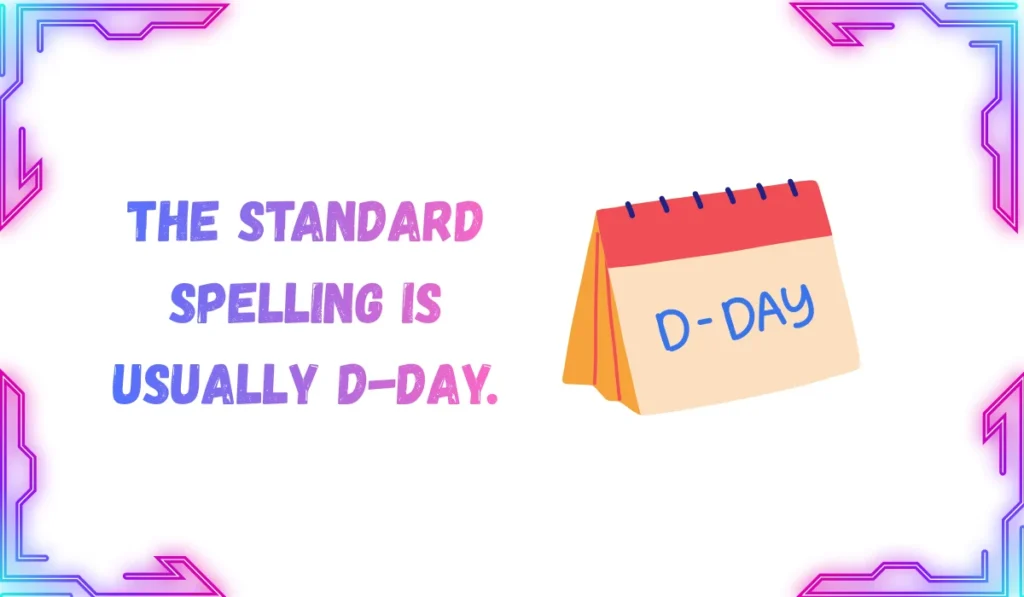
The standard spelling is usually D-Day, with a hyphen.
You may also see D Day written without the hyphen in casual online posts, but D-Day is the more recognized form.
For historical references, D-Day is the standard spelling.
Related Slangs and Abbreviations
If you’re learning modern texting language, several expressions are related to the idea of an important day, deadline, or upcoming event.
TBD
TBD means To Be Determined or To Be Decided.
Example:
“The D-Day is TBD.”
This means the important date hasn’t been decided yet.
TBA
TBA means To Be Announced.
Example:
“The D-Day is TBA.”
The date will be announced later.
ASAP
ASAP means As Soon As Possible.
Example:
“Please finish this ASAP. D-Day is tomorrow.”
FYI
FYI means For Your Information.
Example:
“FYI, D-Day has been moved to Friday.”
BTW
BTW means By The Way.
Example:
“BTW, D-Day is next Monday.”
IMO
IMO means In My Opinion.
Example:
“IMO, D-Day will be the best day of the year.”
These abbreviations are common in texts, chats, social media, and online conversations.
How to Know What D-Day Means From Context
When you see D-Day in a message, ask yourself:
- What are we talking about?
- Has the sender mentioned a specific event?
- Is there a deadline or important date involved?
- Is the conversation about history or World War II?
- Does the message sound serious or playful?
For example:
“D-Day is June 6.”
If the conversation is about World War II, this likely refers to the historical Normandy landings.
But:
“D-Day is June 6! My graduation is finally here!”
Here, the phrase refers to graduation day.
The context tells you everything.
Funny and Relatable Ways People Use D-Day
One reason people like using D-Day casually is that it adds drama to everyday life.
Consider these examples:
“D-Day: I finally have to clean my inbox.”
“Tomorrow is D-Day. I’m telling my crush how I feel.”
“D-Day is here. The Wi-Fi bill is due.”
“It’s D-Day. My mom is coming over, and the house is a disaster.”
“D-Day: The day I promised myself I’d start going to the gym.”
The humor comes from treating a normal event as if it were a massive, world-changing operation.
And let’s be honest, cleaning your room can sometimes feel like one.
D-Day Meaning in Different Contexts
The meaning can change slightly depending on where you see it.
| Context | Likely Meaning |
|---|---|
| Texting | The big or important day |
| Social media | A major upcoming event |
| Work chat | A deadline, launch, or key date |
| Gaming | A major battle, match, or event |
| History | The Allied Normandy landings of June 6, 1944 |
| Military | The designated day an operation begins |
| Casual humor | A dramatically important everyday event |
This is why context matters when interpreting D-Day in text messages.
8 Quick FAQs About D-Day Meaning
What does D-Day mean in texting?
In texting, D-Day usually means an important or big day when something is scheduled to happen. It could be an exam, deadline, wedding, interview, or another major event.
What does the D in D-Day stand for?
The D is generally associated with day. In military terminology, D-Day refers to the designated day when an operation begins.
Does D-Day always refer to World War II?
No. While D-Day is famous for the Allied Normandy landings on June 6, 1944, people also use it casually to mean an important or decisive day.
Is D-Day slang?
It can be used as an informal expression, especially in texts, social media, and casual conversations. However, the term itself originated as military terminology rather than modern internet slang.
What does “D-Day is coming” mean?
It means an important day or event is approaching. The exact event depends on the context of the conversation.
Can I use D-Day for a deadline?
Yes. People sometimes use D-Day to describe a major deadline, especially when the deadline feels important or stressful.
Is D-Day formal or informal?
It’s more common in casual and conversational language. In formal writing, using the exact date or terms such as “deadline” or “launch date” is usually clearer.
What is another way to say D-Day?
Depending on the context, you could say the big day, the important day, the deadline, the launch date, the due date, or the day of the event.
Final Thoughts
The simplest D-Day meaning is an important or decisive day when something major is happening.
In texts and online chats, people often use it to talk about exams, deadlines, weddings, interviews, launches, competitions, and other big moments.
At the same time, remember that D-Day has a significant historical meaning. It is most famously associated with the Allied landings in Normandy on June 6, 1944. So, the right interpretation depends on the conversation and context.